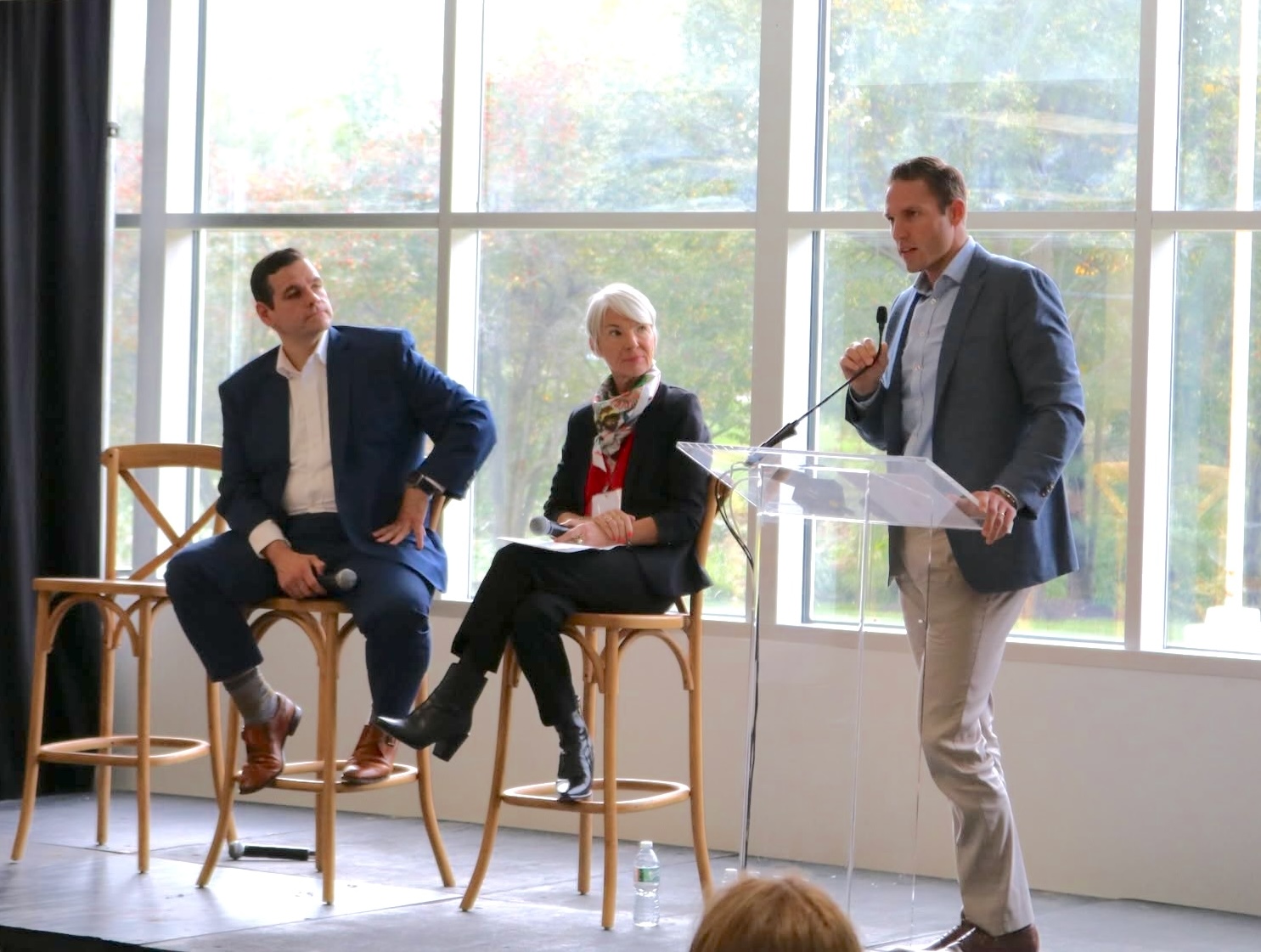
From left to right: George Eastwood, Barbara Lavery, and Bradley Watts (speaking) at BioNJ’s Manufacturing Summit in Princeton, New Jersey.
How do we turn a promising scientific discovery into a cancer therapy that can change and potentially save patients’ lives? The answer requires more than great science. It takes collaboration among researchers, biotechnology companies, manufacturers, investors, clinicians, policymakers, philanthropists, and, above all, patients.
This fall, Barbara Lavery, Chief Program Officer of Alliance for Cancer Gene Therapy (ACGT), saw that collaboration at work during two conferences connected by that shared challenge. First, BioNJ’s Manufacturing Summit in late September in Princeton, New Jersey, the focus was on how complex cell and gene therapies are engineered and produced. Then, at the Global Cancer Research & Innovation Symposium (GCRIS) in early October in New York, the lens shifted to how science and capital come together to move new treatments forward, closer to patients in the clinic. The settings were different, but the question was the same, and so was ACGT’s message: Advancing cancer cell and gene therapy takes investment in bold science, the infrastructure to turn discoveries into treatments, and the systems that make those treatments accessible to patients.
BioNJ’s Manufacturing Summit: Where therapies get built.
Behind every infusion of currently approved CAR T cells is a manufacturing feat. A patient’s own cells are collected, engineered, expanded, tested, and returned. One patient, one batch, with little room for error.
That challenge took center stage at BioNJ’s Manufacturing Summit on September 29, hosted at Catalent’s Cell Therapy Center of Excellence. Biopharmaceutical leaders gathered to discuss the future of manufacturing, supply-chain resilience, regulation, and the delivery of advanced therapies, with special attention to the unique demands of cell and gene therapies.
Lavery joined a fireside chat with Bradley Watts, a CAR T-cell therapy recipient and patient advocate, and George Eastwood, executive director of the Emily Whitehead Foundation. In a day that could easily have centered on production processes, costs, and commercial strategy, their conversation focused instead on what manufacturing decisions mean for the people waiting for treatment.
For a patient, manufacturing capacity, process reliability, turnaround time, and cost are not abstractions or business decisions. They can determine whether a potentially life-changing therapy arrives in time to make a difference.
The summit also featured a regulatory update from Christine Harman, PhD, of the FDA’s Center for Biologics Evaluation and Research, and a discussion on scaling cell and gene therapy manufacturing with Matthew Breton of Tr1X Bio, Peter Keller of BlueWhale Bio, Sanjay Srivastava of Accenture, and Dan Strange of Cellular Origins. The common thread homed in on the fact that next generation of therapies will need manufacturing that is not only more efficient and consistent, but also affordable enough to reach the patients who need them.
For ACGT, this is a core part of our mission, not an afterthought. Funding a bold research idea is the start of the journey. Turning that discovery into a clinical candidate, testing it rigorously, and building a reliable path to treatment are just as important.
Catalent is one of the leaders in advancing cell and gene manufacturing, and ACGT is grateful to John Tomtishen, Global Head, Cell Therapy Field Application Scientists & Strategic Alliances for championing Catalent’s support of ACGT as an Alliance Partner.
The Global Cancer Research & Innovation Symposium: Where science meets capital.
A week later, the conversation moved from the manufacturing site to the investment table.
The Global Cancer Research & Innovation Symposium (GCRIS), hosted October 5–6 at the New York Athletic Club by the Association for Value-Based Cancer Care (AVBCC), is designed to “connect science, capital, and innovation.” Researchers, biotech and pharmaceutical leaders, investors, and policymakers came together to examine how new therapies move from early discovery through clinical development and commercialization – a focus that closely mirrors ACGT’s own work.
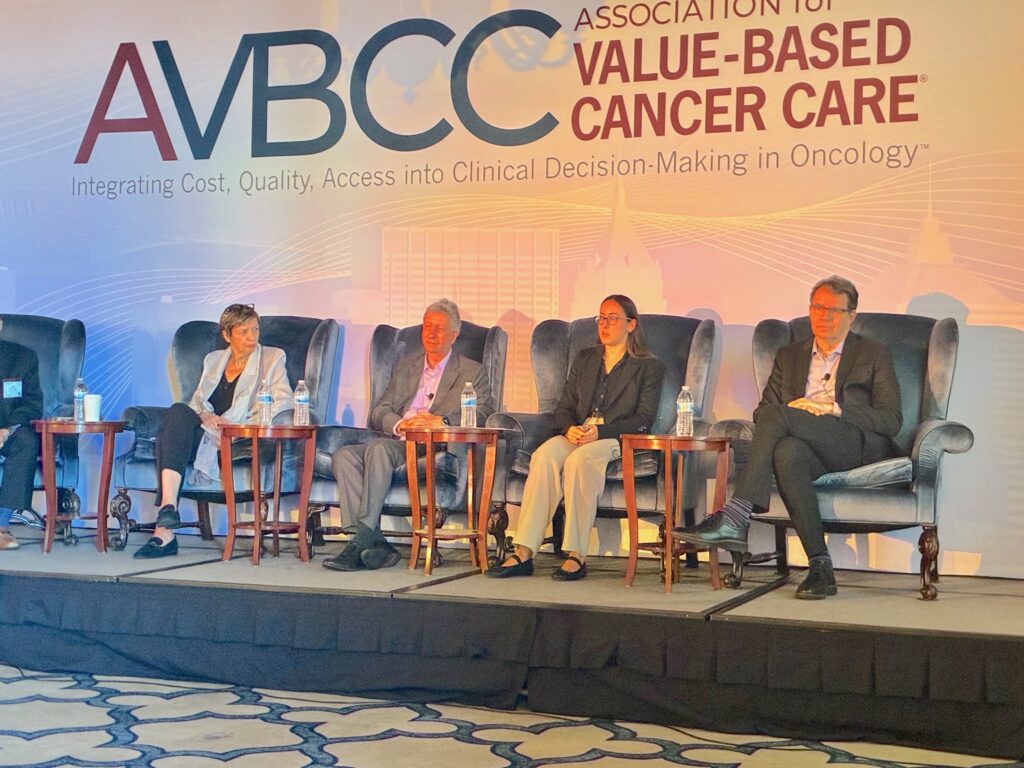
The panel “CAR-T: Moving into a New Era, The Experts Speak” at GCRIS 2026. From left to right: Isabelle Riviere, PhD, Bruce Levine, PhD, Emily Bodnar, and Michel Sadelain, MD, PhD.
ACGT’s scientific community was well represented. Two members of ACGT’s Scientific Advisory Council and one member of our Board of Directors— all pioneers of the field—spoke on the panel “CAR-T: Moving into a New Era, The Experts Speak”:
• Isabelle Riviere, PhD, Executive Director, Strategic Development in Precision Therapeutics, Columbia University
• Michel Sadelain, MD, PhD, Director, Columbia Initiative in Cell Engineering and Therapy, Columbia University
• Bruce Levine, PhD, Barbara and Edward Netter Professor in Cancer Gene Therapy at the University of Pennsylvania’s Perelman School of Medicine and Founding Director of the Clinical Cell and Vaccine Production Facility (CVPF)
Levine’s endowed professorship carries a special connection, as it is named for our co-founders Barbara and Edward Netter, who started ACGT in 2001. Together with Emily Bodnar of H.C. Wainwright & Co., the panelists reviewed advances in CAR T technology and shared insights into how the market is evolving.
In another session, “What’s Next for Innovation and Basic Science Cancer Research,” Friends of Cancer Research President and CEO Jeff Allen, PhD, moderated a discussion of the research-funding environment and the importance of sustaining scientific progress. The panel featured Ross Levine, MD, Chief Scientific Officer at Memorial Sloan Kettering Cancer Center; Wafik El-Deiry, MD, PhD, Director of the Cancer Center at Brown University; Dave Tuveson, MD, PhD, Chief Scientist at the Lustgarten Foundation and Director of the Cold Spring Harbor Laboratory Cancer Center; and Jon Retzlaff, Chief Policy Officer and Vice President of Science Policy and Government Affairs at the American Association for Cancer Research.
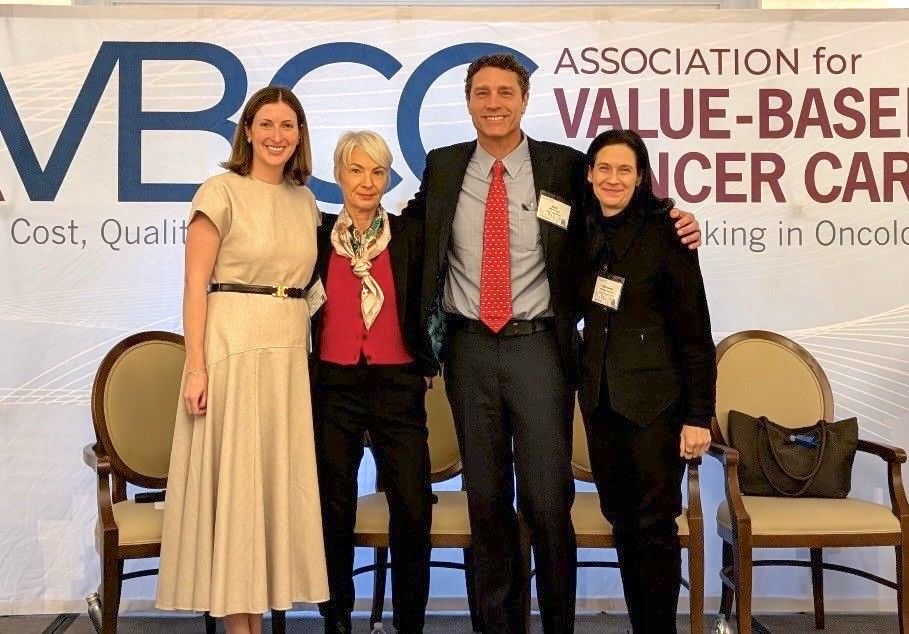
Panelists from “Catalytic Capital and Communities for Cancer Innovation” at GCRIS 2026. From left to right: Kara Whelply, Barbara Lavery, Rob Butcher, Stephanie Oestreich, PhD.
Lavery brought ACGT’s perspective to the panel “Catalytic Capital and Communities for Cancer Innovation,” which explored how nonprofits are evolving beyond traditional grantmaking to act as strategic partners, organizers, and investors. The discussion centered on how philanthropic capital can de-risk early-stage research, attract follow-on funding, and speed the path from discovery to patients. Moderated by Kara Whelply, Associate Director of the Science Philanthropy Accelerator for Research and Collaboration (SPARC) team at the Milken Institute, the panel also included Stephanie Oestreich, PhD, Managing Director of the Myeloma Investment Fund, and Rob Butcher, CEO of Swim Across America.
Why early investment matters.
The two events approached cancer innovation from distinct perspectives. BioNJ focused on the practical work of producing complex therapies reliably and at scale. GCRIS focused on the scientific, financial, and collaborative networks that move new treatments forward.
But both pointed to the same truth, that no breakthrough reaches a patient without diverse sources of support and advocacy. Before manufacturers, investors, or regulators can do their part, someone has to bet on the idea.
That is our role at ACGT, which invests in talented investigators and high-risk, high-reward research that may be too early or too unconventional for traditional pharmaceutical funding. That support helps researchers establish proof-of-concept and generate clinical evidence that attracts further investment and development partners. It is the very kind of catalytic capital Lavery emphasized at GCRIS.
The field has come a long way. Approved CAR T-cell therapies have transformed outcomes for some patients with blood cancers. But major challenges remain, especially for solid tumors such as lung, brain, pancreatic, and ovarian cancers, where effective cell therapy options are still limited.
For donors, this represents an opportunity to support innovation at the stage when a relatively early investment can help shape the direction of an entire field—and change the course of countless lives.
For ACGT Research Fellows, these conversations are a reminder to think beyond the lab and engage early with the partners who will help turn discoveries into treatments. For industry, they show the value of working alongside academic investigators and philanthropic organizations. And for patients and families, they show how many people are working toward the same goal.
For ACGT, this work remains at the heart of our mission: supporting bold cancer research, fostering the partnerships that accelerate progress, and helping bring the next generation of transformative therapies closer to patients.
The ultimate measure of innovation is not simply what we discover. It is what those discoveries make possible for people facing cancer.


