
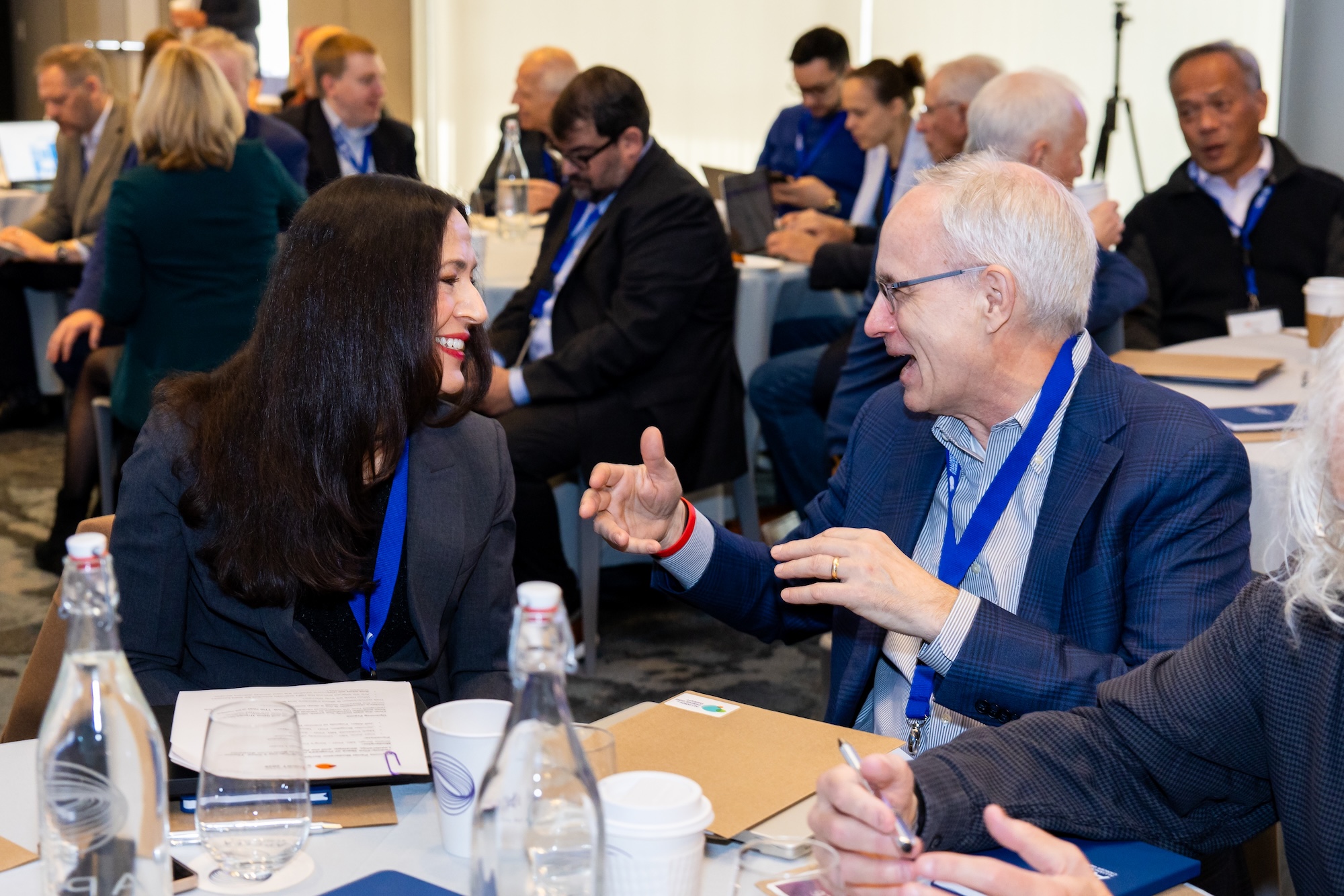
The Society for Immunotherapy of Cancer (SITC) holds its 41st Annual Meeting & Pre-Conference Programs November 4–8 in Phoenix, Arizona, and ACGT hosts our annual lunch symposium on November 6. Across the full conference program, nine ACGT Research Fellows will share their scientific insights as presenters, panelists, and chairs of sessions.
Join us for the ACGT Lunch Symposium on November 6
Heading to SITC 2026? Join the cancer cell and gene therapy community at the ACGT Lunch Symposium to reconnect and hear from leaders in the field.
Our keynote speaker, ACGT Research Fellow Renier Brentjens, MD, PhD—the Katherine Anne Gioia Endowed Chair in Cancer Medicine and Chair of the Department of Medicine at Roswell Park Comprehensive Cancer Center—will join ACGT Board of Directors member Marc Engelsgjerd, MD, of Royalty Pharma, for a fireside chat. Brentjens, an early pioneer of CAR T-cell therapy, is now tackling solid cancers like ovarian with ACGT support.
Ovarian tumors surround themselves with cells that suppress immune attacks, so Brentjens’ armored CAR T cells are engineered to release IL-18, an immune-boosting signal that helps them withstand those defenses and rally the patient’s own immune system. The therapy is now in a Phase 1 clinical trial, for patients with recurrent, platinum-resistant ovarian cancer. “We want to be the Rolls-Royce of CAR T-cell engines,” Brentjens said, “to make an engine that won’t fail.” He also recently shared his views on the field’s future with Gizmodo.
We are also delighted to welcome ACGT Research Fellow Yvonne Chen, PhD—the Co-Director of Tumor Immunology and Immunotherapy and a Professor of Microbiology, Immunology and Molecular Genetics at UCLA Health Jonsson Comprehensive Cancer Center— who will present her work on an armored CAR T-cell therapy for glioma. This type of brain tumor is notoriously resistant to many therapies because the blood-brain barrier keeps many drugs and immune cells at bay, while the brain’s “immune-privileged” environment suppresses immune attacks within. Glioma cells also don’t all carry the same target, so they can escape treatments aimed at just one. Chen’s armored CAR T cells are designed to target and overcome this variability in glioma.
The ACGT symposium takes place Friday, November 6, from 11:30 a.m. to 1:30 p.m. local time in Room 124B of the Phoenix Convention Center. Register now to save your seat.
What to expect at SITC 2026
Engineered immune cells are a major theme of this year’s meeting. Many sessions focus on CAR T-cell therapy, in which a patient’s own T cells are modified to find and attack cancer, and tumor-infiltrating lymphocyte (TIL) therapy, which multiplies immune cells taken from a patient’s tumor. A question running through the program is how to advance these therapies for solid tumors, with the same success they have had in blood cancers.
The pre-conference program on November 4–5 opens the conversation. A regulatory roundtable with FDA experts covers next-generation cell therapies, including armored CARs, off-the-shelf CARs made from donor cells, and genetically modified TILs. The next day, a workshop on new agents features talks on in vivo CAR T, in which cells are engineered inside the body rather than in a lab, along with TCR T-cell therapy and TIL therapy. It also includes a debate on cell therapy versus T-cell engagers, antibodies that link T cells to cancer cells.
On November 6, Session 106a explores combining cell therapy with other treatments, including oncolytic viruses, which infect and destroy cancer cells, to “recharge” CAR T cells. A biotech session on off-the-shelf therapies covers donor-derived CAR T, CAR T generated inside the body, and an early-stage trial of an oncolytic virus. It closes with a debate on in vivo versus ex vivo approaches.
On November 7, Session 207d is devoted to engineering cell therapies to overcome the barriers of solid tumors. Another session that day looks at using AI and protein design to build better cell therapies. New research presented across the meeting includes clinical results for TIL therapy and an engineered T-cell therapy in sarcoma, T cells engineered to target a mutated form of p53, and studies of how the gut microbiome affects TIL therapy. On November 8, Eric Vivier, DVM, PhD, will deliver the CRI William B. Coley Award Lecture, titled “Harnessing NK Cells in Cancer Therapies.”
Beyond cell therapy, the SITC 2026 program covers cancer vaccines, bispecific antibodies, engineered cytokines, and managing immune-related side effects. The Annual Meeting runs November 6–8 at the Phoenix Convention Center.
ACGT Scientists at SITC 2026
Beyond our lunch symposium, nine ACGT scientists appear throughout the SITC program, chairing sessions, giving talks, joining debates, and mentoring early-career researchers. Their topics range from engineering CAR T cells for solid tumors to immunotherapy in the brain and the role of metabolism in treatment response. If you’re in Phoenix, here’s where to find them. All times are local (MT).
• Renier Brentjens, MD, PhD (Roswell Park Comprehensive Cancer Center)
◦ Nov. 6: ACGT Lunch Symposium keynote (see above)
◦ Nov. 6: Panelist, “In Vivo – Ex Vivo Debate,” Session 107b: Biotech Session: The Next Generation of Off-the-Shelf IO (5:00–5:30 p.m.)
• Brian Brown, PhD (Icahn School of Medicine at Mount Sinai)
◦ Nov. 5: Expert, Early Career Scientist Meet-the-Expert Lunch, “Bioinformatics, Big Data, and AI” table (12:00–1:30 p.m.)
◦ Nov. 7: Co-chair, Session 207c: Hot and Cold Tumors; talk, “Identifying Determinants of Hot and Cold Tumors by AI-Assisted Perturb-Map” (5:40–6:00 p.m.); Hot and Cold Tumor Debate (6:20–6:40 p.m.)
• Sidi Chen, PhD (Yale University School of Medicine)
◦ Nov. 7: Talk, “Genetic, Structural, Chemical and In Situ Engineering of Cell Therapy,” Session 207d: Cellular Therapies (5:25–5:40 p.m.)
• Yvonne Chen, PhD (UCLA)
◦ Nov. 6: ACGT Lunch Symposium presentation (see above)
◦ Nov. 6: Co-chair, Session 106a: Combination Therapies Involving Cell Therapy (1:45–3:25 p.m.)
• Greg M. Delgoffe, PhD (University of Pittsburgh)
◦ Nov. 5: Talk, “Funding Your Research Through Industry Collaboration,” Grant Writing Workshop (3:15–3:25 p.m.); breakout table, “Interfacing with Industry (Biotech Grants)” (4:30–5:00 p.m.)
◦ Nov. 7: Co-chair, Session 203: Hot Topic Symposium: External Factors Contributing to Immunotherapy Response; talk, “Postprandial Metabolism and its Potential to Enhance Immunotherapy Responses” (11:00–11:15 a.m.)
◦ Nov. 8: Expert discussant, Session 301: Presidential Session (9:30–9:40 a.m.)
• Marcela V. Maus, MD, PhD (Massachusetts General Hospital)
◦ Nov. 7: Talk, “Learnings From a CAR-T Driver Into Solid Tumor,” Session 207d: Cellular Therapies (5:40–5:55 p.m.)
• Hideho Okada, MD, PhD (University of California, San Francisco)
◦ Nov. 6: Co-chair, Session 107a: Immuno-oncology at Immune-privileged Sites; talk, “The Brain Is Not Immune to Immunity” (4:00–4:20 p.m.)
• Daniel J. Powell Jr., PhD (University of Pennsylvania)
◦ Nov. 5: Expert, Early Career Scientist Meet-the-Expert Lunch, “Translational Research: Mice to Humans” table (12:00–1:30 p.m.); talk, “K or F Awards? Finding Your NIH Career Development Awards,” Grant Writing Workshop (3:05–3:15 p.m.)
• Michel Sadelain, MD, PhD (Columbia University)
◦ Nov. 7: Co-chair, Session 207d: Cellular Therapies (5:20–6:40 p.m.)


